
 by
by 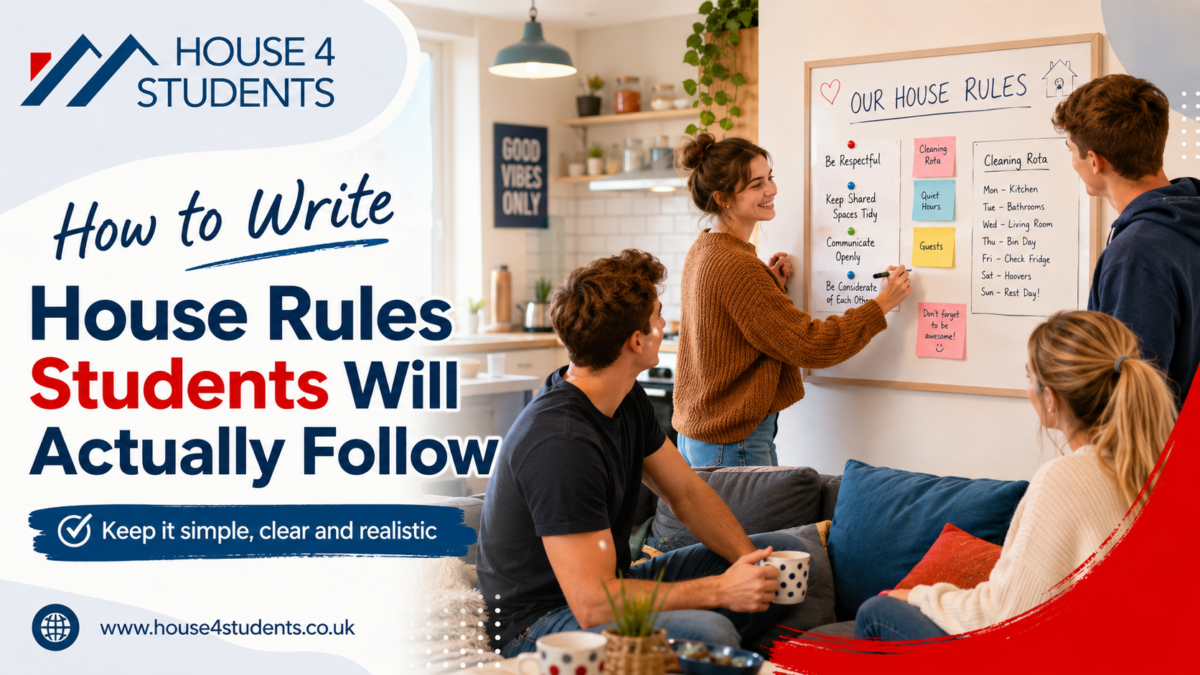
Student house rules can make a shared property easier to manage, but only when tenants actually understand and follow them.
A four-page document filled with warnings, legal language and twenty different “do not” statements is unlikely to achieve much. Students may skim it on move-in day, forget most of it and only rediscover it when there is a disagreement.
Effective student house rules work differently.
They set clear expectations, explain the practical reason behind important rules and make it easier for everyone to live together without unnecessary conflict.
For landlords, that can mean fewer complaints, less avoidable damage and easier communication throughout the tenancy.
Why Student House Rules Matter
A student house is different from many other rental properties.
Several people may be sharing a kitchen, bathrooms, bins, appliances, internet connection and communal spaces for the first time.
Some tenants may have previously lived in halls. Others may be moving away from their parents for the first time.
That creates plenty of opportunities for small misunderstandings.
Who takes the bins out?
How late can music be played?
What happens when somebody has friends staying?
Who reports a leaking tap?
Can tenants leave belongings in hallways?
Good student house rules answer these questions before they become arguments.
They are particularly useful alongside a clear tenancy agreement and a practical move-in guide.
Landlords who want to establish good relationships from the beginning can also read our guide to choosing better student tenants and our advice on what makes a great student landlord in 2026.
House Rules Are Not a Replacement for the Tenancy Agreement
There is an important distinction between house rules and contractual tenancy terms.
Your tenancy agreement sets out the legal arrangement between landlord and tenant. A house guide can then explain practical expectations about living in the property.
Do not assume that writing something on a laminated sheet gives a landlord unlimited power to enforce it.
House rules should be consistent with the tenancy agreement and tenants’ legal rights.
In England, most private renters have had assured tenancies since 1 May 2026, and landlords must provide specified written information about the tenancy.
Tenants also have the right to live in their home without unnecessary interference from their landlord. Shelter describes this as the right to quiet enjoyment.
If you want a particular condition to form part of the tenancy contract, obtain appropriate professional advice rather than relying solely on a separate house-rules sheet.
1. Keep Your Student House Rules Short
The easiest way to make rules ineffective is to create too many.
Students are far more likely to remember ten clear expectations than forty detailed instructions.
Concentrate on the behaviours that genuinely affect:
- Safety
- Other housemates
- Neighbours
- Property condition
- Repairs
- Security
- Shared areas
Avoid creating rules simply because something personally annoys you.
The purpose is to help the household function properly, not to control every aspect of how tenants live.
2. Use Normal Language
Avoid writing:
“Occupiers must ensure that refuse receptacles are presented for municipal collection at the appropriate designated time.”
Write:
“Please put the bins out on Tuesday evening for Wednesday collection.”
The second version tells tenants exactly what to do.
Student house rules should sound like practical instructions rather than clauses copied from a legal document.
Use short sentences and specific actions wherever possible.
3. Explain Why Important Rules Exist
People are often more willing to follow a rule when they understand its purpose.
For example:
Instead of:
“Do not leave belongings in the hallway.”
Try:
“Please keep hallways and stairs clear so escape routes remain unobstructed.”
Fire safety is particularly important in shared houses. Landlords have legal responsibilities around property safety, alarms and escape routes, with additional requirements applying to some HMOs.
A short explanation turns an apparently arbitrary rule into something that makes sense.
4. Make Noise Rules Realistic
“NO NOISE” is not a realistic rule for a student house.
People will talk, cook, watch television, play games and occasionally have friends visiting.
A better approach is to set an expectation of consideration.
For example:
Keep music, television and conversations at a reasonable level, particularly late at night and early in the morning. Please be considerate of housemates and neighbours.
You can also remind tenants that bass speakers, open windows and groups talking outside can create more disturbance than they realise.
Noise between housemates is already a common source of student housing frustration, as we discuss in our guide to student housing complaints in 2026.
The objective should be respectful living rather than pretending students will live silently.
5. Be Clear About Guests
Guest rules are one of the areas where vague wording creates unnecessary disputes.
Students naturally expect friends, partners and relatives to visit.
Instead of attempting to supervise every visitor, explain the practical concerns.
These might include:
- Respecting other housemates
- Keeping noise reasonable
- Preventing overcrowding
- Making sure visitors do not cause damage
- Maintaining security
- Following any legitimate tenancy conditions
Tenants should also understand that they may be responsible for damage caused by people they invite into the property. Government guidance notes that tenants can be responsible for damage caused by visitors they allow into the home.
Keep any restrictions reasonable and make sure they are consistent with the tenancy agreement and applicable law.
6. Make Cleaning Responsibilities Specific
“Keep the house clean” sounds sensible but tells tenants very little.
One person may think a kitchen is clean because the plates have been washed. Another may expect worktops, floors, ovens and bins to be cleaned every day.
Instead, explain what matters.
For example:
Kitchen
Wipe surfaces after cooking, wash up promptly and remove expired food from the fridge.
Bathrooms
Leave shared bathrooms reasonably clean after use and report leaks or ventilation problems.
Communal areas
Do not leave rubbish, takeaway containers or personal belongings in shared spaces for long periods.
There is an important balance here.
Landlords should not transfer legal maintenance responsibilities to tenants simply by writing them into house rules. Government guidance confirms that landlords remain responsible for various safety and property obligations.
7. Explain the Bin System
Bins cause a surprising number of problems in student houses.
Do not simply tell tenants to “manage rubbish properly”.
At move-in, provide:
- Collection day
- Which bin is used for what
- Where bins should be stored
- When they should be moved for collection
- What tenants should do with large items
A photograph showing the correct bins can be even more useful.
This is exactly the type of practical information students appreciate because it eliminates guesswork.
8. Make Reporting Repairs a House Rule
One of the most useful student house rules is also one of the simplest:
Report maintenance problems promptly.
Tenants sometimes ignore small problems because they assume somebody else will report them.
A slow leak then becomes damaged flooring.
A small patch of damp becomes mould.
A loose door handle eventually breaks.
Give tenants one clear reporting route, such as an email address, portal or management number.
Ask them to include a short description, location and photograph where possible.
Landlords should respond promptly too. Clear communication is a two-way responsibility.
Our guide to student housing complaints explains why slow repairs and poor communication can quickly damage the landlord-tenant relationship.
9. Include Basic Condensation Guidance
Damp and mould can involve many different causes, so house rules should never be used to automatically blame tenants.
However, landlords can provide simple guidance on everyday moisture management.
For example:
- Use extractor fans when cooking and showering.
- Avoid blocking ventilation.
- Report persistent condensation or mould.
- Tell the landlord if an extractor fan stops working.
- Report leaks immediately.
The property must still be kept safe and free from health hazards, and landlords retain their legal repair and safety responsibilities.
The important message is therefore not “mould is your fault”.
It is:
Help us identify moisture problems early so we can investigate them properly.
10. Include Security Rules Everyone Can Understand
Security expectations should be straightforward.
For example:
Please lock external doors and accessible windows when leaving the house. Do not give keys or access codes to people who do not live at the property. Report lost keys and damaged locks promptly.
This protects the entire household.
It is also worth showing tenants how doors and window locks work during check-in rather than assuming everybody understands the system.
11. Make Fire Safety Rules Non-Negotiable
Some house rules are about convenience.
Fire safety is different.
Students should understand that they must never:
- Disable or cover smoke alarms
- Interfere with fire-safety equipment
- Block escape routes
- Wedge designated fire doors open where this compromises their function
- Ignore damaged alarms or safety equipment
Explain how to report a fault immediately.
For HMOs, additional fire-safety obligations can apply. GOV.UK provides guidance covering landlord safety responsibilities, and landlords should also check their local authority’s HMO and licensing requirements.
12. Do Not Use Automatic Deposit Threats
Avoid writing rules such as:
“£50 will automatically be deducted from your deposit if the kitchen is dirty.”
Deposit deductions should not operate like arbitrary fines.
Instead, explain the expectation and document the property’s condition properly.
Detailed inventories, photographs and clear records make genuine end-of-tenancy claims much easier to support.
Our student deposit disputes guide explains why evidence is so important when landlords seek deductions for damage, cleaning or missing items.
House rules should encourage good behaviour rather than threaten tenants with unsupported charges.
13. Give Students the Rules Before Problems Start
The worst time to introduce a rule is immediately after somebody has broken it.
Give tenants the house rules:
- Before or at move-in
- In the welcome pack
- Digitally by email or tenant portal
- In a short printed version where useful
Walk through the most important points during check-in.
You do not need to read every sentence aloud.
Instead, highlight the essentials:
Repairs. Fire safety. Bins. Noise. Security. Shared areas.
Then tell tenants where they can find the full guide.
A Simple Student House Rules Template
A practical house-rules sheet could look something like this:
Welcome to Your Student House
We want the property to be a comfortable home for everyone. These simple house rules help protect you, your housemates, the property and our neighbours.
Noise
Please keep music, televisions and conversations at a considerate level, particularly late at night.
Guests
Visitors are welcome where permitted under your tenancy, but please respect your housemates, neighbours and the property.
Cleaning
Clean up after yourself in shared kitchens, bathrooms and living areas.
Bins
Use the correct bins and put them out on the designated collection day.
Repairs
Report leaks, heating problems, electrical faults, mould or other maintenance concerns promptly.
Security
Lock external doors and windows when leaving the property. Never share keys or access codes with unauthorised people.
Fire Safety
Never tamper with alarms or other safety equipment. Keep stairs, hallways and escape routes clear.
Smoking and Vaping
Follow the smoking and vaping conditions stated in your tenancy agreement.
Damage
Tell us promptly if something is accidentally damaged. Reporting a problem early usually makes it easier to resolve.
Respect
Please treat your housemates, neighbours and the property with consideration.
Questions?
If you are unsure about anything, contact the landlord or managing agent rather than guessing.
That is usually far more useful than several pages of threats and prohibitions.
Common House Rule Mistakes Landlords Should Avoid
House rules tend to fail when landlords:
Create too many rules.
Important expectations disappear among minor instructions.
Use vague language.
“Be tidy” means different things to different people.
Set unrealistic expectations.
A shared student house will never look exactly like an empty property photograph every day.
Treat students like children.
Students are tenants paying to live in their home.
Introduce new rules whenever something goes wrong.
Important expectations should be explained from the start.
Ignore their own responsibilities.
Rules work better when tenants can see that the landlord also responds to repairs, communicates clearly and keeps the property properly maintained.
Threaten instead of explaining.
Clear expectations are generally more effective than aggressive notices.
Rules Work Better When the Property Works
Even perfectly written student house rules cannot compensate for poor property management.
It is difficult to tell tenants to prevent condensation if the extractor fan has been broken for three months.
It is difficult to insist that they keep the kitchen organised when there is inadequate storage for six people.
And it is difficult to demand good communication while ignoring maintenance messages.
Students are more likely to respect reasonable rules when they feel the landlord is also keeping their side of the relationship.
That means providing a safe, functional property, explaining responsibilities clearly and dealing with problems professionally.
For more guidance on preventing common problems, explore the House4Students landlord blog or browse practical advice and student accommodation information through House4Students.
Practical Takeaways
The best student house rules are:
- Short
- Specific
- Easy to understand
- Reasonable
- Relevant to shared living
- Consistent with the tenancy
- Focused on safety and consideration
- Explained before problems occur
Most importantly, write them for the people who have to follow them.
A rule nobody understands is unlikely to change behaviour.
A simple instruction with an obvious reason behind it has a much better chance.
Final Word
Writing student house rules should not be about creating the longest possible list of restrictions.
It should be about removing uncertainty.
Students need to understand how the house works, what is expected of them and what they should do when something goes wrong.
Landlords need a clear framework that helps protect the property while respecting the fact that it is the tenants’ home.
Get that balance right and student house rules can prevent arguments, reduce avoidable damage and make a shared property easier for everyone to manage.
Simple rules. Clear reasons. Consistent communication.
That is far more effective than another laminated page covered in DO NOT signs.
References
GOV.UK – Landlord responsibilities
GOV.UK – Landlord safety responsibilities
GOV.UK – How to Rent a Safe Home

Join The Discussion