 by House4Students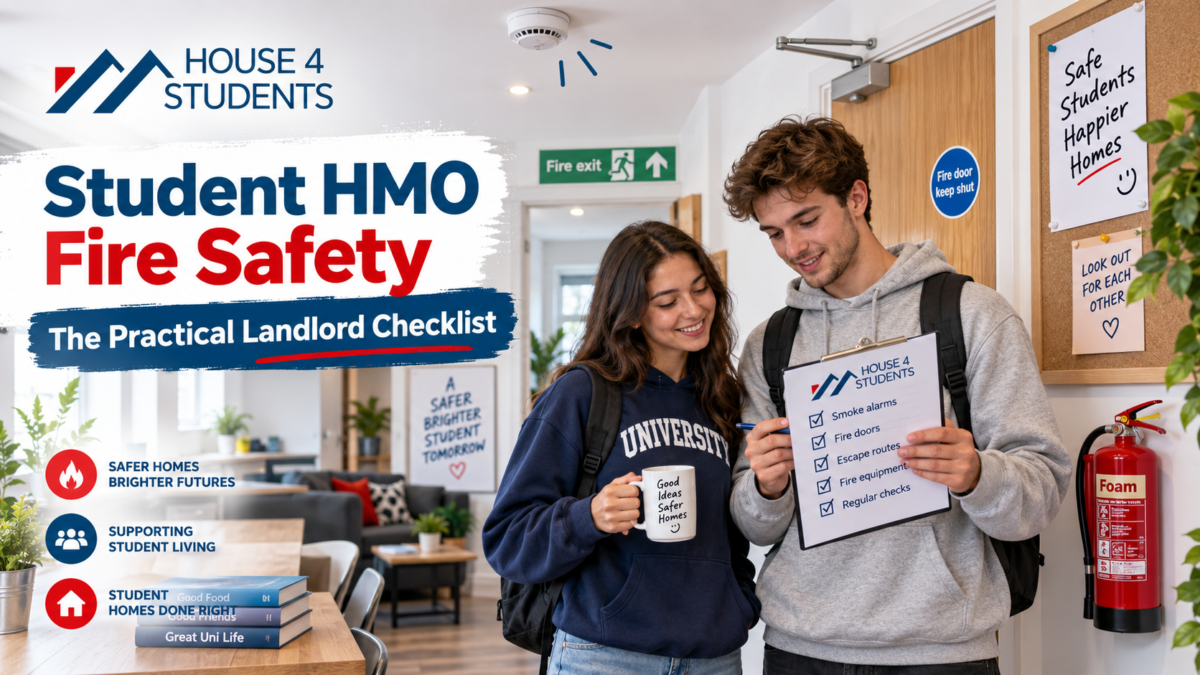
Student HMO Fire Safety: The Practical Landlord Checklist
Fire safety is one area of student HMO management where landlords cannot afford to become complacent.
A smoke alarm that worked at the start of the academic year may later develop a fault. A fire door can be damaged. Students may leave bicycles, boxes or furniture in a hallway. Extension leads can multiply as more devices appear in bedrooms. Even a well-managed property can develop new risks during a tenancy.
That is why every landlord should have a student HMO fire safety checklist and use it regularly.
This guide focuses primarily on HMOs in England. Requirements vary elsewhere in the UK, and local councils can impose additional or stricter conditions through HMO licensing schemes.
For more practical advice on managing student accommodation, browse the House4Students landlord blog or visit House4Students UK.
First: Know Whether Your Property Is an HMO
In England, a property will generally be an HMO where at least three tenants from more than one household live in the property and share facilities such as a kitchen, bathroom or toilet.
Mandatory HMO licensing normally applies where a property is occupied by five or more people forming more than one household, although councils can operate additional licensing schemes covering smaller HMOs.
Always check your local authority’s requirements rather than assuming that a smaller student house falls outside licensing rules.
1. Keep Your Fire Risk Assessment Current
A fire risk assessment should never become a document that is completed, filed away and forgotten.
The assessment should consider how a fire could start, who may be at risk, whether people can escape safely and whether the precautions already in place remain suitable.
Government fire-safety guidance for sleeping accommodation specifically includes HMOs and highlights issues such as escape routes, warning systems and the characteristics of the people occupying the building.
Your assessment may need reviewing when:
- The property layout changes
- Occupancy changes significantly
- Alterations or refurbishment take place
- New equipment or appliances are installed
- Fire-safety equipment is changed
- An incident or near miss occurs
- An inspection identifies a new problem
Where you do not have the knowledge to complete a suitable assessment yourself, use an appropriately competent fire-risk assessor.
2. Check Smoke and Heat Detection
Smoke detection is one of the most important parts of a student HMO’s fire-safety system.
In England, relevant rented properties must have at least one smoke alarm on every storey containing living accommodation. Carbon monoxide alarms are also required in rooms used as living accommodation containing a fixed combustion appliance, excluding gas cookers. Faulty prescribed alarms must be repaired or replaced once the landlord is informed and the fault is established.
However, the minimum domestic alarm rules should not be treated as the complete specification for an HMO.
Your HMO licence, fire risk assessment and local authority requirements may require a more comprehensive alarm and detection system.
Check:
- Smoke alarms are present where required
- Heat detection is provided where specified
- Interlinked alarms operate correctly where required
- Alarm heads are clean and unobstructed
- Batteries or backup batteries are functioning
- Tenants have not removed, covered or disabled alarms
- Faults are repaired promptly
- Testing and maintenance records are retained
Do not guess which grade or category of alarm system your HMO requires. Check the licence conditions and obtain competent fire-safety advice where necessary.
3. Inspect Fire Doors Properly
A fire door is only useful if it can perform as designed.
During property inspections, look for obvious damage and deterioration rather than simply checking that a door marked “fire door” is still hanging in its frame.
Look at:
- Door closers
- Door frames
- Hinges
- Intumescent or smoke seals where fitted
- Glazing
- Significant gaps
- Damage to the door leaf
- Locks and latches
- Doors being wedged open
A self-closing fire door should not routinely be propped open with a shoe, bin, chair or doorstop.
If you are uncertain whether a door meets the required standard, arrange an inspection by a competent contractor instead of relying on appearance alone.
4. Keep Escape Routes Clear
Hallways, stairs, landings and exits can quickly become informal storage areas in a student house.
Boxes arrive after moving day. Bicycles are brought indoors. Delivery packaging accumulates. Shoes, drying racks and furniture gradually creep into communal spaces.
Under the Management of Houses in Multiple Occupation Regulations, HMO managers must keep means of escape from fire free from obstruction and maintain them in good order and repair.
During inspections, check for:
- Bicycles blocking corridors
- Furniture in hallways
- Rubbish or cardboard near exits
- Locked or obstructed final exits
- Damaged stairways
- Storage beneath stairs where inappropriate
- Decorations or belongings interfering with fire equipment
Explain the reason clearly to tenants. This is not about keeping communal areas aesthetically perfect. It is about making sure everyone can get out quickly in an emergency.
The House4Students guide to student house rules also recommends telling tenants never to interfere with alarms and to keep stairs, hallways and escape routes clear.
5. Check Electrical Fire Risks
Student properties can place significant demands on electrical systems.
One bedroom might contain a gaming PC, monitor, television, phone charger, laptop, hair dryer and several other devices. Problems arise when multiple extension leads, damaged chargers or overloaded sockets are added to the mix.
In England, landlords must have rented-property electrical installations inspected and tested by a qualified person at least every five years, with the resulting electrical report supplied as required.
Between formal electrical inspections, look out for:
- Scorched sockets
- Loose fittings
- Damaged cables
- Excessive extension leads
- Overloaded adaptors
- Buzzing or overheating equipment
- Damaged landlord-supplied appliances
- Tenant reports of tripping circuits
Any warning signs should be investigated rather than left until the next scheduled electrical inspection.
6. Pay Attention to E-Bikes and Lithium Batteries
E-bikes, e-scooters, power banks and other rechargeable devices are increasingly common in student households.
Your fire risk assessment should consider where rechargeable equipment is stored and charged.
Discourage charging equipment in escape routes or communal circulation areas where a fire could prevent tenants from leaving the building.
Damaged, modified or incompatible batteries and chargers should be treated particularly seriously.
Clear guidance in the house information pack can help prevent unsafe charging from becoming normal behaviour.
7. Check Kitchens for Preventable Risks
Kitchens are naturally one of the highest-risk areas of a shared student house.
During inspections, look beyond general cleanliness.
Check for:
- Grease accumulating around cooking equipment
- Combustible items beside hobs
- Damaged appliances
- Faulty sockets
- Damaged extractor fans
- Smoke or heat detectors being covered
- Unsafe extension leads
- Fire doors being wedged open
Students should also understand basic kitchen fire safety when they move in.
Simple instructions are usually more effective than pages of technical wording.
8. Keep Gas Appliances Properly Maintained
Where the property contains landlord-supplied gas appliances, landlords must arrange an annual gas safety check by a Gas Safe registered engineer.
Tenants must also receive the required gas-safety record.
Do not ignore signs such as:
- Boiler faults
- Unusual smells
- Sooting
- Damaged appliances
- Carbon monoxide alarm activation
Gas safety and fire safety should be managed together rather than as completely separate compliance exercises.
9. Check Carbon Monoxide Alarms
In England, carbon monoxide alarms are required in rooms used as living accommodation containing a fixed combustion appliance, with gas cookers excluded from that specific requirement.
Make checking CO alarms part of your routine inspection process.
Record:
- Where alarms are installed
- Date checked
- Condition
- Any reported fault
- Repair or replacement date
Records can help demonstrate that safety issues are being actively managed.
10. Check Fire-Fighting Equipment Required for Your HMO
Depending on the property, fire risk assessment and licence conditions, your HMO may require specific fire-fighting equipment.
Do not automatically install equipment simply because another landlord has it in their property.
Instead, establish what is required for your particular HMO, then make sure it remains accessible, correctly positioned and properly maintained.
HMO fire precautions should follow your property’s risk assessment and applicable local authority requirements.
11. Give Students Clear Fire-Safety Information
Students should know what to do before an emergency happens.
At move-in, explain:
- What the alarm sounds like
- What tenants should do if an alarm activates
- Where the exits are
- Why escape routes must remain clear
- Why fire doors must not be wedged open
- How to report a faulty alarm or damaged fire door
- Basic safe charging guidance
- Emergency contact arrangements
Keep the explanation short enough that tenants will actually remember it.
Good communication is also part of being a responsible landlord. Our guide to what makes a great student landlord explains why safety, maintenance and quick responses matter as much as the appearance of the property.
12. Include Fire Safety in Mid-Tenancy Inspections
Fire safety should not only be checked when tenants arrive.
A property can change significantly during an academic year.
During a mid-tenancy inspection, check:
- Smoke and heat detection
- Carbon monoxide alarms
- Fire doors
- Hallways and stairs
- Final exits
- Electrical warning signs
- Fire-safety equipment
- Kitchen risks
- Signs of tampering
- New charging or storage risks
Our mid-tenancy inspection checklist for student HMOs includes fire-safety equipment, alarms, fire doors and escape routes among the areas landlords should inspect.
13. Keep a Fire-Safety Record
Good records make ongoing management much easier.
Maintain a digital or physical file containing relevant:
- Fire risk assessments
- Review dates
- Alarm tests
- Alarm servicing records
- Fire-door inspections
- Electrical reports
- Gas safety records
- Contractor invoices
- Repairs
- Photographs
- Tenant safety information
- Access attempts
- HMO licence conditions
The objective is not paperwork for the sake of paperwork.
It is creating a clear history showing what was checked, what was found and what action was taken.
The Practical Student HMO Fire Safety Checklist
Before finishing an inspection, confirm that:
✓ Fire risk assessment remains appropriate
✓ HMO licence conditions have been checked
✓ Smoke alarms are operational
✓ Heat detection is functioning where required
✓ Carbon monoxide alarms are present and working where required
✓ Fire doors show no obvious damage
✓ Self-closers operate correctly where fitted
✓ Escape routes are unobstructed
✓ Final exits can be used safely
✓ No fire equipment has been tampered with
✓ Electrical warning signs have been investigated
✓ Gas safety certification is current
✓ Kitchen fire risks have been checked
✓ Charging equipment is not creating an escape-route hazard
✓ Required fire-fighting equipment is maintained
✓ Tenants know how to report fire-safety defects
✓ Inspection and maintenance records are up to date
Final Thoughts
A student HMO fire safety checklist should be treated as an ongoing management tool rather than something used only when applying for a licence.
Properties change. Tenants change. Equipment deteriorates. New risks appear.
Regular checks help landlords identify those problems before they become emergencies.
Most importantly, do not assume that the fire precautions required in one HMO automatically apply to another. Property layout, occupancy, construction, fire risk assessment and local licensing conditions can all affect what is required.
Check the property’s licence conditions, use competent professionals where necessary and act quickly when defects are found.
For more guidance on inspections, maintenance and managing student accommodation, visit the House4Students blog.
This article provides general information and is not a substitute for property-specific fire-safety, legal or local-authority advice.