
 by
by 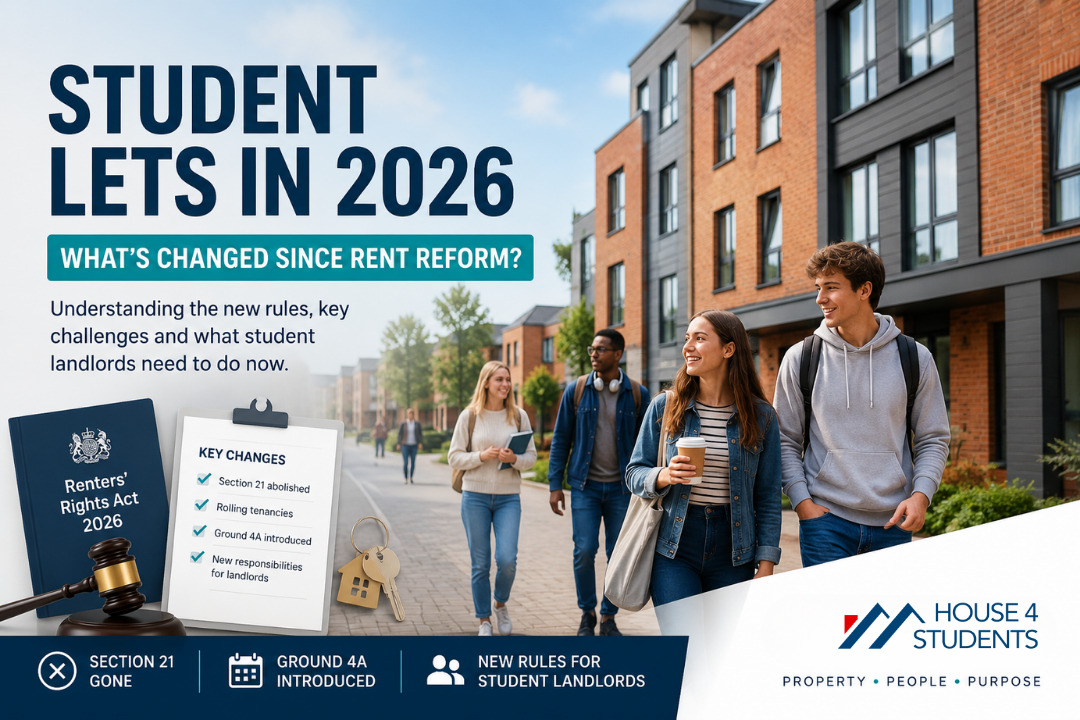
The dust is beginning to settle on the single biggest piece of legislation to affect the private rented sector (PRS) in England for decades. The road to the Renters’ Rights Act 2026 was long, marked by consultations, campaigns, and significant government U-turns. For student landlords, the level of uncertainty was unprecedented. Now that the reforms are fully in force, let’s cut through the noise and analyze exactly what has changed, and what it means for student Lets.
The central pillar of the old student housing model was the 12-month, fixed-term tenancy. This gave students security for the academic year and landlords a guaranteed income, with a clear-cut summer turnaround to re-let to the next cohort. This entire structure was built on the foundation of Section 21, which was abolished for new and existing tenancies on May 1, 2026. The private student HMO sector has been profoundly shifted.
This detailed guide breaks down the legal changes, the practical impacts, and the concrete steps landlords should be taking to manage their portfolio effectively in this new landscape.
What Actually Changed in Law
The final version of the Renters’ Rights Act implemented the majority of the original proposals, but not without crucial modifications following intense campaigning from the National Residential Landlords Association (NRLA) and student accommodation providers.
Here is the legal reality in 2026:
1. Rolling Tenancies: The New Default
Assure Shorthold Tenancies (ASTs) are gone. From May 1, 2026, all new and existing tenancies automatically converted into Assured Periodic Tenancies (APTs). These are open-ended “rolling” tenancies with no fixed end date. Students now have the flexibility to end their tenancy at any time by giving two months’ notice in writing. For landlords, this means the end of a guaranteed 12-month income.
2. End of Section 21
Landlords can no longer serve a “no-fault” eviction notice. Section 21 is abolished. To regain possession, a landlord must rely on one of the specific statutory grounds under Section 8 of the Housing Act. For student landlords, this was the primary cause for alarm, but a specific remedy was introduced.
3. The Mandatory Ground for Student HMOs: Ground 4A
Following significant lobbying, a mandatory ground for possession was introduced specifically to preserve the annual cycle of student lets. This is ‘Ground 4A’. It allows a landlord to regain possession of a student House in Multiple Occupation (HMO) over the summer, provided they can prove they intend to re-let the property to a new group of student tenants.
For Ground 4A to be effective, three strict criteria must be met:
- HMO Status: The property must be a licensed or unlicensed HMO.
- Student Status: All occupants must be full-time students at an educational establishment.
- Advanced Notice: Students must be given a specific written statement at the very beginning of their tenancy, informing them that Ground 4A may be used to end the tenancy over the summer.
4. PBSA vs Private Student HMOs: A Two-Tier System
The 2026 reforms have solidified a massive divide in the student housing market. The rules for Purpose Built Student Accommodation (PBSA) are fundamentally different.
- Qualifying PBSA: Accommodation managed or controlled by an educational establishment and part of an approved code (like ANUK/Unipol) is formally exempt from the Renters’ Rights Act. These providers can continue to grant fixed-term, non-assured contracts and collect rent in advance. They do not have to worry about rolling tenancies or Ground 4A.
- Private Student HMOs: All other shared student houses are caught by the full force of the reforms. They must follow the periodic tenancy rules and are reliant on the complex Ground 4A to guaranteed their annual cycle.
Practical Impact on Student Landlords
While Ground 4A provides a legal path for summer re-letting, the shift to rolling tenancies has introduced new operational challenges and significant anxieties for private HMO owners.
1. Mid-Year Leavers and Joint Tenancy Break-ups
The single biggest change is the risk of partial voids. Students can now give two months’ notice. This introduces the realistic possibility that one or two tenants could decide to leave mid-year, breaking up a large joint tenancy and leaving the landlord with a shortfall or the difficult task of finding replacements mid-academic cycle. This requires meticulously managing [external link: Ofcom statistics on UK household broadband usage] to ensure new tenants have reliable connections for their studies from the moment they arrive.
2. Increased Void Risk and Summer Turnaround Challenges
Even with Ground 4A, the timeline for summer turnaround has become tighter and more bureaucratically demanding. For tenancies agreed after May 1, landlords must give four months’ mandatory notice to use Ground 4A to guarantee summer vacation, which then requires court action for enforcement. Any error in notice could leave a landlord in a void position for the entire next year. For the very first summer of 2026, transitional guidance reduced this notice to two months for tenancies agreed before May 1, a complexity that many agents struggled to navigate.
3. Why Some Landlords Are Nervous
The nervous energy is palpable. The loss of Section 21 means that evictions for antisocial behavior or significant rent arrears now depend on court proceedings, which many fear will lead to protracted delays. The complexity of Ground 4A—requiring checking tenant student status, serving multiple notices correctly, and managing the potential for mid-year departures—has made the sector significantly more intensive to manage, leading some small landlords to sell up.
What Landlords Should Do Now
ThePrivate Student HMO market remains a viable investment, but only for those who are meticulous and proactive.
Here is a checklist of actionable steps you must take to ensure your student properties [external link: Citizens Advice guide on landlord responsibilities for repairs] are compliant and competitive in this new world:
- Review and Redraft ALL Contracts:
- Transition your agreements to the periodic model.
- Explicitly include the mandatory written statement regarding the potential use of Ground 4A at the start.
- Ensure all necessary prescribed information (How to Rent guide, EPC, EICR, Gas Safety, deposit) is provided, and have tenants sign to acknowledge receipt. A clean documentary trail is a mandatory prerequisite for Ground 4A.
- Conduct Rigorous Agent Checks:
- Are they fully compliant with the correct 4-month notice requirements for Ground 4A?
- Do they have a system in place to track the mandatory statement requirement and transitional summer rules?
- Verify they are prepared for the upcoming landlord registration scheme (PRS Database), which is phased for late 2026 and 2027. We help our portfolio owners [internal link: www.house4students.co.uk/info-for-landlords/] keep ahead of these changes.
- Formalize Your Replacement Tenant Process:
- Have a clear procedure for managing individual mid-year leavers. Create clear protocols for re-letting part of a joint tenancy and the steps current tenants must follow to propose suitable replacements. Maintain written records of these agreements.
- Consider Incentives for Longer Stays:
- While you cannot mandate a longer stay, you can encourage it. Consider offering rent discounts, parking, or bills-included packages (including high-speed [external link: Ofcom statistics on UK household broadband usage]) for students who sign a “re-let intention” statement that guarantees a tenancy extension for the next academic year.
- Develop Worst-Case Scenario Planning:
- Plan for partial voids. Budget for the administrative and void costs associated with finding replacement tenants mid-year.
- Build relationships with local universities and PBSA providers to understand local demand for partial HMO vacancies.
The landscape has changed, but the requirement for high-quality, professional student accommodation has not. The key to navigating 2026 and beyond is preparation. We are here to help you get started.


Join The Discussion